Everything First-Time Patients Need to Know About Liposuction Michigan
@simonjagd686
October 21, 2026 · 15 min read
Choosing liposuction for the first time usually starts long before any consultation is booked. For many people, it begins with a stubborn area that has not changed despite steady workouts, careful meals, and months or years of trying to "lean out" in the usual ways. The lower abdomen still holds on. The flanks blur the waist. The inner thighs rub no matter how much weight is lost. At that point, the question often shifts from whether more discipline is needed to whether body contouring might solve a problem that diet and exercise cannot.
For patients considering Liposuction Michigan providers, the challenge is not just understanding the procedure itself. It is knowing who makes a good candidate, what kind of result is realistic, how Liposuction Michigan recovery actually feels, and which details matter when choosing a surgeon. Those practical questions shape the experience far more than marketing language ever will.
Liposuction can be a very effective contouring tool. It can also disappoint people who expect it to behave like a weight-loss method, a skin-tightening treatment, or a shortcut to a different body type. The best first-time patients are not the ones who arrive with perfect knowledge. They are the ones willing to ask clear questions and hear honest answers.
What liposuction really does, and what it does not
Liposuction removes localized pockets of fat to improve shape and proportion. It does not treat obesity. It does not replace healthy habits. It also does not automatically tighten loose skin to the degree many patients hope for.
That distinction matters. A patient may be at a stable, healthy weight and still carry fullness beneath the chin, around the bra line, or at the outer thighs. Those are classic examples of areas that can respond well to liposuction. On the other hand, a patient who has significant skin laxity after weight loss may need a different surgical plan, such as a tummy tuck or body lift, because removing fat alone can leave the skin looking looser.
In practice, the most satisfied patients tend to say something like this: "I like my overall body, but this one area does not match the rest of me." That mindset is usually more compatible with the purpose of liposuction than hoping for a dramatic change in total body weight.
Why people in Michigan often approach the decision carefully
Patients exploring Liposuction Michigan options often do so with a practical mindset. Many are balancing work schedules, family demands, winter weather, athletic routines, and a realistic timeline for recovery. That influences both when they schedule surgery and how they plan aftercare.
Season can matter more than many first-time patients expect. Compression garments are easier to tolerate in cooler months. On the other hand, some people want surgery timed well before summer vacations or weddings. Recovery logistics also matter in a state where weather can complicate driving to follow-up appointments. If a surgeon's office is far from home, it is worth thinking through transportation, especially for the first day or two.
There is also a broader cultural point worth mentioning. In many Midwestern communities, patients do not always talk openly about cosmetic procedures. That can make people feel underinformed at the exact moment they most want straight answers. A good consultation should fill that gap with specifics, not vague reassurance.
Who tends to be a strong candidate
Good candidacy is less about chasing a single number on the scale and more about the whole picture. Surgeons generally look for patients who are near a stable weight, in good overall health, and bothered by areas of excess fat that have remained resistant over time. Skin quality matters. Muscle tone matters. Smoking status matters. So does medical history.
A strong candidate usually has enough skin elasticity to allow the treated area to retract reasonably well after fat removal. Age alone does not decide this. A younger patient can have poor elasticity, and a patient in their fifties can have surprisingly good tone. Genetics, sun exposure, pregnancy history, weight fluctuations, and tissue quality all play a role.
It also helps when expectations are precise. "I want a more defined waistline" is a better starting point than "I want to look totally different." The first goal can often be translated into a realistic surgical plan. The second usually signals that more conversation is needed.
Areas commonly treated
Liposuction is versatile, but it is not identical from one body area to another. Removing fat from the upper abdomen is different from contouring the neck. The tissue behaves differently, swelling settles on a different timeline, and the margin for subtle contour changes varies.
Common treatment areas include the abdomen, flanks, thighs, hips, upper arms, back, chest, chin, and neck. Some patients treat one area only. Others combine several zones in one surgery. Combined treatment can be efficient, but it also increases operative scope, recovery demands, and swelling.
A waistline case, for example, often involves the abdomen and flanks together because treating just one of those areas can leave the body looking unbalanced. Similarly, liposuction under the chin may create a stronger jawline only if the skin has enough recoil and the anatomy supports it.
Techniques you may hear about during consultation
First-time patients are often surprised by how many terms are used in body contouring consultations. Traditional suction-assisted liposuction, tumescent liposuction, power-assisted liposuction, ultrasound-assisted methods, and laser-assisted techniques all come up depending on the practice. The names can sound dramatic, but the most important issue is not which device has the flashiest branding. It is whether the chosen technique suits your anatomy and your surgeon uses it skillfully.
Tumescent liposuction is widely used and involves infiltrating fluid into the treatment area to reduce bleeding and make fat removal safer and more controlled. Power-assisted systems use a vibrating cannula that can help efficiency and precision in some cases. Energy-based tools may be discussed when a surgeon thinks there could be some secondary skin contraction benefit, though those benefits have limits and should not be overstated.
This is where experience matters. A beautifully contoured result usually comes from judgment, restraint, and an eye for proportion, not from gadgetry alone. Many revision cases happen because too much fat was removed, the removal was uneven, or the original treatment plan failed to respect the body's natural contours.
What happens at the consultation
A useful consultation should feel less like a sales pitch and more like a detailed planning session. The surgeon should review your health history, medications, previous surgeries, weight stability, and goals. They should examine the areas of concern standing up, not just while you are seated. They should talk plainly about skin quality, asymmetry, and what cannot be fixed with liposuction alone.
Expect a discussion about where fat can be removed safely, whether multiple areas should be treated together, what type of anesthesia may be used, and how much downtime to plan for. Photos are usually part of the process, and many surgeons will mark or physically show the exact contours they would address.
This is also the moment to ask direct questions. Not because you are being difficult, but because good cosmetic surgery depends on aligned expectations.
- Ask how often the surgeon performs liposuction on your specific areas of concern.
- Ask whether your skin quality is likely to support a smooth result.
- Ask what the recovery looks like at one week, two weeks, and six weeks.
- Ask what results are realistic for your frame, not for a model in a brochure.
- Ask how revisions are handled if healing creates contour irregularities.
Those questions usually reveal far more than asking which machine the practice uses.
Anesthesia and the day of surgery
Liposuction can be performed under local anesthesia, sedation, or general anesthesia depending on the areas treated, the amount of work planned, and the surgeon's approach. Small, focused cases may be done with local anesthesia and oral or intravenous sedation. Larger or combined procedures often require general anesthesia.
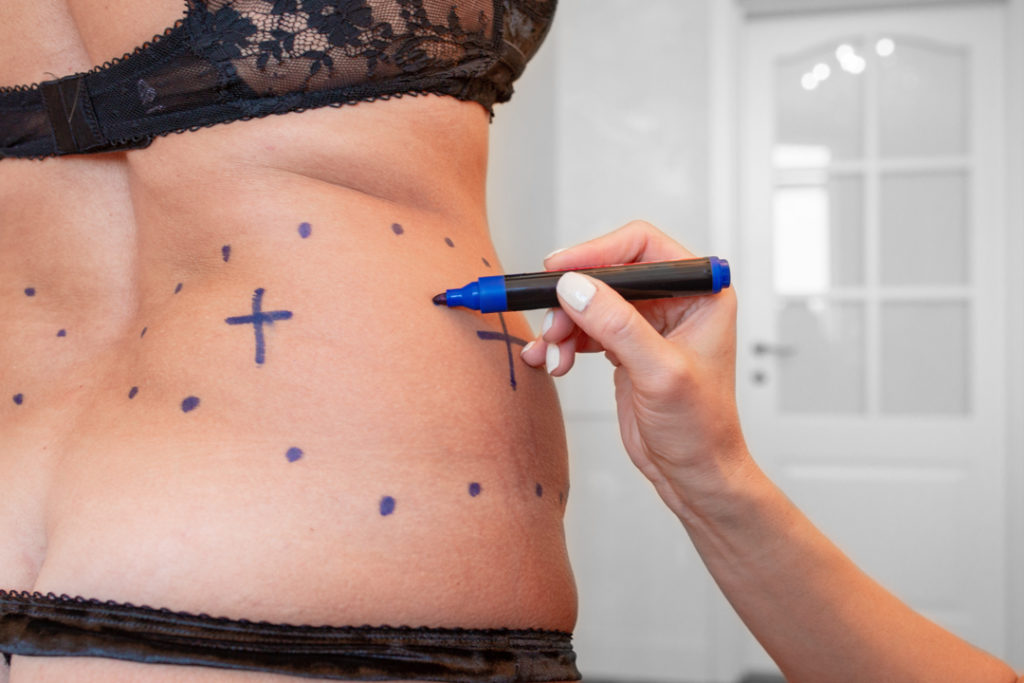
On the day of surgery, the treatment areas are marked while you are standing. This part matters because contour changes are planned according to how the body naturally falls under gravity. Once you are in the operating room, sterile preparation is done, fluid is infiltrated, and the surgeon removes fat through small incisions using a cannula.
Patients often imagine these incisions will be prominent. In most cases, they are small and placed thoughtfully, though any incision can leave a visible scar depending on healing tendencies and placement. Good surgeons think about access and aesthetics at the same time.
Surgery time varies. A small chin case is very different from circumferential torso contouring. Your surgeon should give you a range rather than a hard promise.
Recovery, without the sugarcoating
Recovery is one of the most misunderstood parts of liposuction. It is usually manageable, but it is rarely effortless. Most patients describe soreness more than sharp pain. It often feels like a deep bruise, intense workout soreness, or tenderness after a fall. Swelling can be significant. Drainage from the small incision sites is common in the first day or two, particularly after tumescent liposuction.
Compression garments are standard after surgery, and they are not optional if you want a smoother healing process. They help control swelling and support the tissues as they settle. They can also be annoying, hot, and awkward under clothing. That is normal.
Many people can return to light desk work within several days to a week, depending on the extent of surgery and their comfort. Jobs that involve lifting, bending, or long hours on your feet may require more time. Exercise is usually reintroduced gradually. Walking starts early, often right away, but hard workouts wait until your surgeon clears you.
There is also the emotional side of recovery. Week one is not when most people look in the mirror and think they made a brilliant decision. They are swollen, bruised, and uneven. Clothing may fit strangely before it fits better. This stage catches a lot of first-time patients off guard. The body often looks worse before it looks better.
A practical recovery timeline often looks something like this:
- The first few days are focused on rest, walking, hydration, compression, and managing drainage and soreness.
- By one to two weeks, bruising starts to fade, swelling remains noticeable, and many patients feel well enough for routine daily activity.
- At four to six weeks, contour changes are easier to see, though residual swelling is still common.
- Over several months, tissues soften, small irregularities often settle, and the final shape becomes more apparent.
That last phase tests patience. Liposuction results are not instant, even though before-and-after galleries can make them seem that way.
Risks and complications worth understanding
Every surgery carries risk, even when performed by a qualified surgeon in an appropriate setting. With liposuction, the discussion should include bleeding, infection, fluid accumulation, changes in sensation, contour irregularities, asymmetry, scarring, delayed healing, anesthesia-related risks, and blood clots. Larger-volume procedures may carry greater systemic risk and need particularly careful planning.
Contour irregularity is one of the most important issues for first-time cosmetic patients to understand. Liposuction is not just about removing fat. It is about removing the right amount from the right planes while preserving smooth transitions. Too much removal can create dents, waviness, or an over-operated look. Too little can leave the patient underwhelmed. That balance is why surgeon judgment matters as much as technical skill.
Some concerns are not preventable in a perfect way because human bodies are not naturally symmetrical. One hip may sit higher. One flank may hold more fat. One side may swell differently. A good surgeon points these things out before surgery rather than letting the patient discover them afterward.
Cost in Michigan, and why price alone can mislead you
When people search for Liposuction Michigan pricing, they often find wide ranges. That is normal. Cost depends on the number of areas treated, surgical complexity, anesthesia, facility fees, geographic market, and surgeon experience. A small localized treatment may cost much less than multi-area contouring. Some quotes include garments and follow-up care, while others separate them out.
The cheapest quote is rarely the best deal if it leaves out key costs or comes from a setting that cuts corners. The most expensive quote is not automatically superior either. Price should be interpreted in context. Ask what is included. Ask where the procedure is performed. Ask who provides anesthesia. Ask how follow-up and possible touch-ups are handled.
There is also a difference between value and volume. A surgeon who performs liposuction regularly and can explain your anatomy in a nuanced way may save you far more in the long run than a lower upfront price that leads to revision surgery later.
How to choose a surgeon without getting lost in marketing
A polished website is easy to build. Reliable surgical judgment is not. Credentials matter, but so does specialization. Training, certification, hospital privileges when relevant, and an established track record in body contouring all deserve attention.
Before-and-after photos can help, but they should be read carefully. Look for patients with body types similar to yours, not just dramatic transformations on unusually ideal candidates. Check whether the after photos are consistent in lighting, posture, and timing. Results shown at six months or more often tell a more honest story than early post-op photos.
Pay attention to the consultation experience. Did the surgeon identify trade-offs before you asked? Did they mention limitations? Did they note existing asymmetries? Did they explain why another procedure might suit you better if that were the case? Transparency is usually a stronger sign of quality than enthusiasm alone.
The role of skin quality, cellulite, and body shape
One of the most common misunderstandings is the idea that liposuction can smooth cellulite. Usually, it cannot, at least not in a predictable or comprehensive way. Cellulite is related to skin structure and fibrous attachments, not just excess fat. In some patients, liposuction may leave cellulite unchanged. In others, it can make textural issues more apparent if the overlying skin is thin or lax.
Body shape also matters. Liposuction can improve your proportions, but it cannot redesign your skeleton. If your ribcage, pelvis, and natural fat distribution create a certain silhouette, surgery can refine that shape, not replace it entirely. Patients who understand this tend to appreciate meaningful, natural improvement. Patients who chase a completely different frame often remain frustrated.
Combining liposuction with other procedures
Sometimes liposuction works best alone. Sometimes it is part of a larger plan. A patient with abdominal fullness and loose skin after pregnancy may benefit much more from a tummy tuck with or without liposuction than from liposuction by itself. A patient seeking breast reduction of side fullness may combine arm or bra-line contouring. Facial cases may be paired with skin tightening or neck work if the anatomy calls for it.
Combined surgery can be efficient, but it increases recovery demands. More areas treated usually means more swelling, more garment management, and more fatigue in the first week or two. The right plan depends on health, goals, and how much downtime the patient can realistically take.
Life after surgery, and how to protect your result
Fat cells removed by liposuction do not simply reappear in the same quantity, but the remaining fat cells can still enlarge with weight gain. That means results are durable, not magical. If weight remains stable, contour improvement usually lasts well. If weight fluctuates significantly, body shape can change again.
This is why many surgeons prefer patients to reach a maintainable lifestyle before having surgery. A patient who sees liposuction as a finishing step after consistent habits often does very well. A patient using it as a starting point for future health changes may struggle to preserve the result.
The good news is that satisfaction tends to be high when expectations are grounded. Clothes fit better. Proportions look more balanced. Patients often say they stop obsessing over the one area that bothered them for years. That is a subtle outcome, but for the right person, it is significant.
When it may be better to wait
Not Liposuction Michigan every interested patient should move forward immediately. If your weight is still changing, if you recently had a major medical issue, if you are planning pregnancy soon, or if your goals are still vague, waiting can be the smarter decision. The same is true if your main concern is loose skin rather than fullness.
There is also value in waiting if the first consultation leaves you confused or pressured. Cosmetic surgery should not feel rushed. If the recommendation changes dramatically from one office to another, that is often a sign to slow down, gather more information, and seek another opinion.
A final practical perspective for first-time patients
The best first-time liposuction patients are rarely the ones who know the most technical terminology. They are the ones who understand the fundamentals. Liposuction is for contour, not major weight loss. Recovery is real. Swelling lasts longer than expected. Skin quality shapes the result as much as fat volume does. A great surgeon brings honesty to the process, not just confidence.
If you are researching Liposuction Michigan practices, focus on judgment, safety, communication, and consistency. Ask specific questions. Look for restraint in promises. Make sure the treatment plan fits your body rather than a trend. When done well and for the right reasons, liposuction can deliver refined, lasting improvements that feel proportionate and natural, which is exactly what most first-time patients are hoping for.
Aesthetic Plastic Surgery & Laser Center, Michelle Hardaway M.D.
27920 Orchard Lake Rd, Farmington Hills, MI 48334, United States
+1 248-221-1957
FAQ About Liposuction Michigan
Is 55 too old for liposuction?
Age 55 alone does not determine suitability. A surgeon evaluates overall health, skin quality, healing risks, and realistic goals. A personal consultation is needed to assess candidacy and discuss alternatives.
What happens 10 years after liposuction?
Contour improvements can last, especially with stable weight. Aging, pregnancy, and weight changes can alter the appearance over time. Results vary, and liposuction does not prevent future body changes.
Can lipo get rid of an apron belly?
Liposuction reduces localized fat but does not remove hanging excess skin. An apron belly may require assessment for a skin-removal procedure instead of, or alongside, fat removal. A qualified plastic surgeon can explain appropriate options and their risks.